Spanish wines: regions and designations of origin
Some wines speak of mountains, others evoke the sea, and some preserve in every glass the sun, wind and stone of the place where they were born. Exploring Spanish wines means discovering precisely that: an extraordinary variety of landscapes, grapes and approaches to winegrowing.
From the Atlantic whites of Galicia to Andalusia’s fortified wines, via the reds of the Ebro Valley and the volcanic wines of the Canary Islands, each area has a personality of its own.
Would you like to learn more about Spain’s main wine regions and designations of origin? In this guide, we take a tour of some of the most representative and pause in one of the most historic: our PDO Cariñena.
What defines Spanish wines?
To speak of Spanish wines is to speak of diversity. There is no single style that defines them; instead, there are thousands of different interpretations born from the relationship between the vineyard, the climate and the people who work the land.
A diversity of climates, soils and landscapes
Spain is home to Atlantic, Mediterranean, continental, island and mountain vineyards. Its soils may be limestone, clay, sand, granite or volcanic, or covered with stones.
All these differences influence how the grapes ripen and explain why the same variety can express itself in such different ways depending on where it is grown.
In our region, for example, the cierzo wind, the altitude, low rainfall and stony soils shape wines with a distinctive personality.
Native grape varieties take centre stage
Another of the great strengths of Spanish wine is its wealth of grape varieties. Tempranillo, Garnacha, Cariñena, Albariño, Verdejo, Monastrell and Godello are just some of the grapes that reflect the identity of Spain’s regions.
Each brings different aromas, structure, freshness or intensity. This is why learning about the grape varieties is also a way to understand where each wine comes from.
Winemaking tradition and innovation in Spanish wineries
Winemaking in Spain has centuries of history, yet it remains firmly connected to the present.
Today, many wineries combine knowledge passed down through generations with research, technology, the recovery of old vines and new winemaking techniques.
This balance also defines the craft at the heart of PDO Cariñena: observing the vineyard, respecting its natural rhythm and evolving without losing sight of its origins.
How many wine designations of origin are there in Spain?
Spain currently has 106 wine Protected Designations of Origin (PDOs) and 43 Protected Geographical Indications (PGIs). The PDO category encompasses several classifications, including Denominación de Origen (DO), Denominación de Origen Calificada (DOCa), Vino de Calidad and Vino de Pago.
These quality schemes protect the geographical origin of wines and establish rules governing permitted grape varieties, cultivation, yields and production methods. Ultimately, a designation offers a guarantee of each wine’s provenance and its connection to the region.
Cariñena: nearly a century as a Designation of Origin and two thousand years of history
Cariñena was officially recognised as a Designation of Origin in 1932, although its winegrowing history began much earlier. The Iberians and Romans were already cultivating vines in these lands and, for centuries, wine has been part of the life, economy and culture of its towns and villages.
Today, as we approach our centenary as a designation, in Cariñena we continue to write the story that began more than two thousand years ago. The stony soils, the influence of the cierzo wind, the altitude and varieties such as Garnacha and Cariñena shape the identity of our wines, which are deeply rooted in their place of origin.
Map of Spain’s wine Designations of Origin
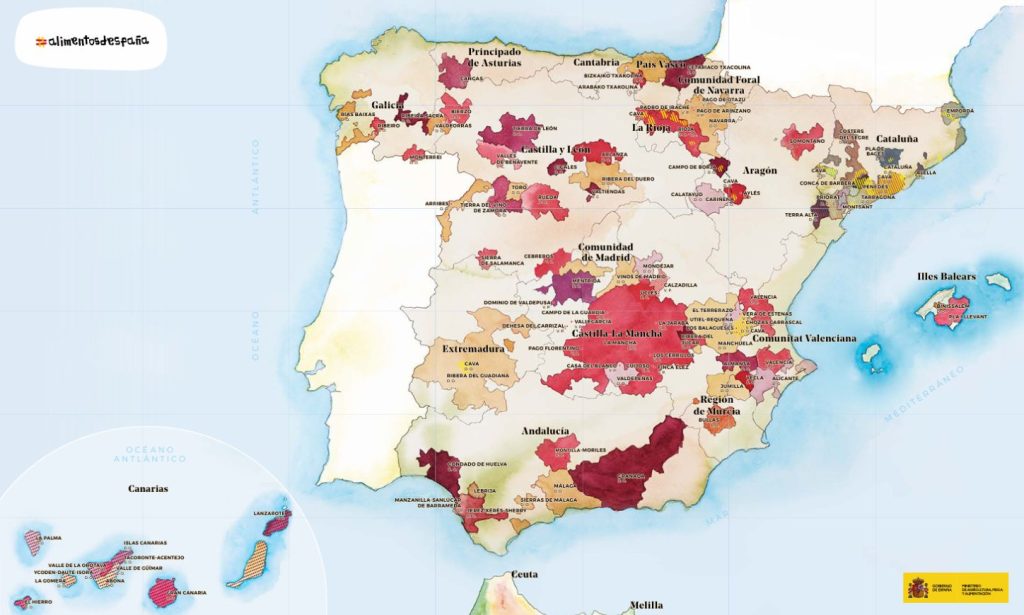
What are Spain’s wine Designations of Origin?
Spain’s designations of origin are found across almost the entire country. Although each has its own regulations and distinctive features, they can be grouped into broad geographical areas:
The Ebro Valley and northern Spain
Northern Spain is home to Cariñena, Campo de Borja, Calatayud, Somontano, Aylés, Urbezo, Rioja and Navarra, as well as the Basque designations Arabako Txakolina, Bizkaiko Txakolina and Getariako Txakolina.
This area produces a wide range of wines, from fresh txakolis to fine reds made from Garnacha, Cariñena and Tempranillo. In PDO Cariñena, you can discover red wines with remarkable depth and a strong sense of place.
Castile and León and the Duero basin
Ribera del Duero, Rueda, Toro, Bierzo, Cigales, Arribes, Arlanza, Tierra del Vino de Zamora, León and Cebreros are among the best-known designations in Castile and León.
In this region, shaped by altitude, cold winters and sharp variations in temperature, Tempranillo, Mencía and Verdejo take centre stage.
Galicia and Atlantic wines
Galicia encompasses the PDOs of Rías Baixas, Ribeiro, Ribeira Sacra, Valdeorras and Monterrei. Its green landscapes, the influence of the ocean and varieties such as Albariño, Godello, Treixadura and Mencía produce fresh, expressive wines.
Castile-La Mancha and central Spain
In Castile-La Mancha and central Spain, the designations of origin La Mancha, Valdepeñas, Manchuela, Méntrida, Uclés, Ribera del Júcar, Mondéjar and Almansa sit alongside numerous Vinos de Pago. This vast, diverse area is particularly known for varieties such as Airén, Tempranillo and Garnacha Tintorera.
The Valencian Community and the Region of Murcia
Alicante, Valencia and Utiel-Requena represent the vineyards of the Valencian Community, while Jumilla, Yecla and Bullas are Murcia’s three major designations.
In both regions, Bobal and Monastrell are essential varieties, particularly for producing Mediterranean-style reds and rosés.
Andalusia and its fortified wines
The designations Jerez-Xérès-Sherry, Manzanilla-Sanlúcar de Barrameda, Montilla-Moriles, Málaga, Sierras de Málaga, Condado de Huelva, Granada and Lebrija reflect the diversity of southern Spain.
Although Andalusia is renowned for its fortified and sweet wines, it also produces highly regarded whites and reds.
Wines from the Canary Islands and the Balearic Islands
The Canary Islands are home to Abona, El Hierro, Gran Canaria, La Gomera, La Palma, Lanzarote, Tacoronte-Acentejo, Valle de Güímar, Valle de La Orotava, Ycoden-Daute-Isora and Islas Canarias.
In the Balearic Islands, Binissalem and Pla i Llevant are particularly noteworthy. Their local varieties and island conditions produce distinctive wines with a deep connection to the landscape.
Other Designations of Origin in Spain
Catalonia is home to Priorat, Penedès, Montsant, Terra Alta, Tarragona, Costers del Segre, Empordà, Pla de Bages, Alella, Conca de Barberà and Catalunya, among others. There are also designations that span more than one autonomous community, such as Cava, which covers several regions of Spain.
They are joined by Vinos de Madrid in Madrid, Ribera del Guadiana in Extremadura and Cangas in Asturias.
The result is a winegrowing mosaic that is hard to find anywhere else in the world.
What makes DO Cariñena so special among this wealth of Spanish wines?
Cariñena has something few other regions can claim: it is a place, a designation and also the name of a grape variety.
Our landscape also captures much of the essence of Spanish wine. Here, vines grow among stones and contend with the cierzo wind, dry conditions and sharp variations in temperature. These conditions help to produce wines with a distinctive sense of origin.
Garnacha and Cariñena are the two leading varieties, and the region allows them to be used to create a wide range of styles: from intense reds to fresh white wines and wonderfully expressive rosé wines.
Ultimately, discovering Cariñena means exploring one of Spain’s most historic designations and finding, in every glass, the imprint of stone, wind, vines and the work of generations.
Spanish grape varieties
Now that you know more about Spain’s principal designations of origin, it is time to return to where Spanish wines begin: the grape.
Spain preserves an extraordinary heritage of native grape varieties:
- Leading red varieties include Tempranillo, Garnacha Tinta, Cariñena, Monastrell, Bobal, Mencía, Graciano, Maturana Tinta, Prieto Picudo, Brancellao, Sumoll, Callet and Listán Negro.
- White varieties include Albariño, Verdejo, Airén, Macabeo, Garnacha Blanca, Godello, Treixadura, Xarel·lo, Parellada, Palomino, Pedro Ximénez, Moscatel de Alejandría, Hondarrabi Zuri, Malvasía Volcánica and Listán Blanco.
Alongside these, many Spanish regions also grow international varieties such as Cabernet Sauvignon, Merlot, Syrah, Chardonnay and Sauvignon Blanc. They all coexist in a country where every landscape finds its own way to express itself.
As you can see, exploring Spanish wines means travelling, discovering stories and understanding how every region leaves its mark on the wine. And PDO Cariñena is undoubtedly a wonderful place to begin that journey. Are you ready to discover it?